
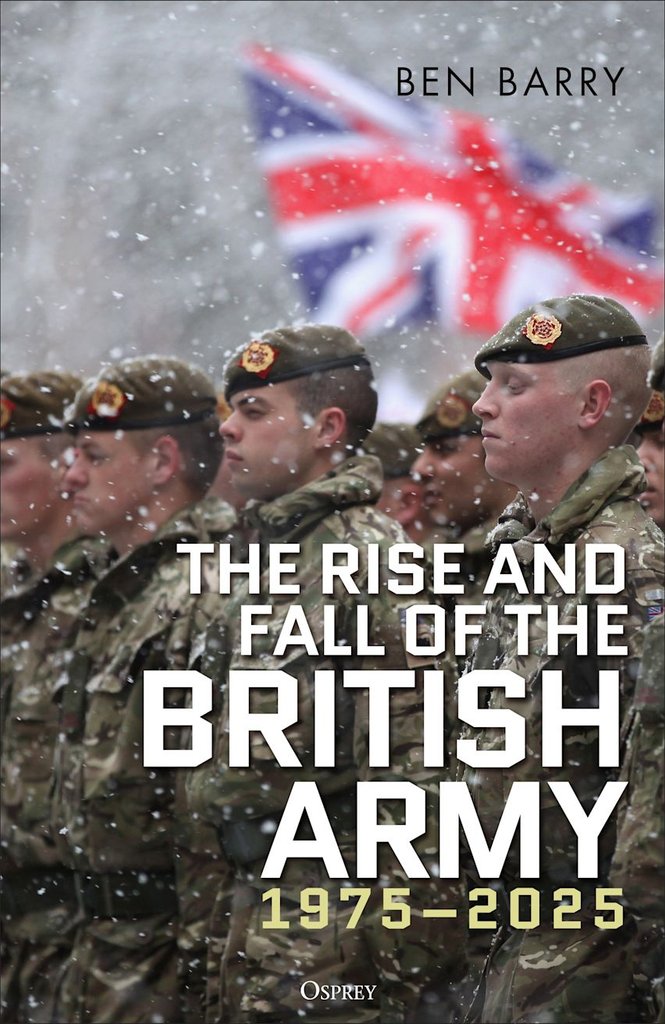
The Rise and Fall of the British Army, 1975–2025, by Ben Barry, examines how Britain’s land forces grew to peak operational strength in the late Cold War before shrinking to half their 1970 size.
Starting from a strained period in the 1970s, the British Army underwent major doctrinal and tactical reforms, led by figures like General Sir Nigel Bagnall, alongside increased Thatcher-era defence funding. New equipment like Challenger main battle tanks and Warrior infantry fighting vehicles prepared the force for high-intensity armoured warfare against the Soviet Union.
Barry highlights the British Army’s operational effectiveness across the 1982 Falklands War, counter-terrorism operations in Northern Ireland, the 1991 Gulf War, Balkans peacekeeping, and the early stages of Afghanistan (2001) and Iraq (2003).
Strategic mistakes in Iraq and Afghanistan eroded public and political support for overseas deployments. Combined with post-Cold War “peace dividend” budget cuts, successive defence reviews, and flawed procurement programmes, the Army’s troop numbers and combat formations steadily contracted.
By the 2020s, the force was roughly half its 1970 manpower, leaving it stretched thin with ageing equipment and limited capacity for prolonged peer-on-peer conflict.
Brigadier (Retd) Ben Barry OBE is Senior Fellow for Land Warfare at the International Institute for Strategic Studies. He served in the British Army from 1975 to 2010, holding several key staff appointments, and has continued to work closely with the British Army since.
