

HMS DASHER (D37) was a Royal Navy Avenger-class escort carrier that suffered an internal explosion and sank in the Firth of Clyde between Ardrossan and the Isle of Arran on 27 March 1943. The vessel sank within eight minutes with the loss of 379 of the 528 crew members, in one of the worst Royal Navy losses in home waters.
The vessel was constructed by the Sun Shipbuilding Company in Pennsylvania as a passenger and cargo ship and was launched on 11 April 1941. It was later converted into an escort carrier at the Tietjen & Lang shipyard in New Jersey before being transferred to the Royal Navy and commissioned into service as HMS DASHER (D37) on 2 July 1942, under the Lend-Lease scheme.
Since the Avenger-class escort carriers were converted American merchant ships, they were not built to the same specifications as Royal Navy and US Navy vessels. One significant issue was fuel storage, as well as leaking fuel tanks. As a result, DASHER had to remain at Tietjen & Lang shipyard until August 1941 to address several defects.
The aft aircraft lift on DASHER, which brought aircraft up from the hangar to the flight deck, was often kept lowered and used for ventilation purposes, specifically to help disperse the dangerous build-up of flammable petrol vapour from the hangar deck below.
Before sailing for Operation TORCH, the Allied invasion of Vichy French-controlled North Africa, additional modifications were made to DASHER’s fuel supply and magazine at Greenock. During the operation, DASHER, along with its sister ships HMS AVENGER (D14) and BITER (D79), supported the Allied landings in November 1942.
On 15 November, AVENGER was struck by a torpedo fired by the German submarine U-155 off the coast of Gibraltar. The torpedo hit the port side amidships, causing a catastrophic explosion that ripped through the Bomb Room, igniting stored ammunition and blowing out the centre section of the ship. AVENGER sank within 5 minutes with only 12 out of its crew of 528 surviving.1
Following Operation TORCH, DASHER sailed to Liverpool for engine repairs. Afterwards, it headed north to escort convoys bound for Russia. In February 1943, while operating off the coast of Iceland, DASHER encountered severe weather that caused significant damage, forcing it to sail to Dundee for repairs.
It was while undergoing work at Dundee that DASHER’s new commander, Captain L. A. K. Boswell, came aboard. An officer on DASHER later recalled that at Dundee, a strange man came on to the ship and requested the keys to the ammunition storage area, to which Captain Boswell gave permission. The man later slipped off the vessel, leaving the keys under a pile of bed sheets left for washing in a corridor.2 Once the repairs were completed, DASHER proceeded to Rosyth before sailing to Scapa Flow and then to the Clyde, where she arrived at Greenock on 23 March.3
On 27 March 1943, DASHER was out in the Firth of Clyde conducting exercises with the ship’s embarked Sea Hurricanes and Swordfish torpedo bombers, with the Hurricanes practising fighter intercepts and the Swordfish aircraft simulating strikes on ships, possibly in preparation for a strike against the German battleship TIRPITZ in Norway, which was a major threat to the convoys.
After training was completed for the day, Captain Boswell announced over the tannoy that the ship would sail back to Greenock, where the crew were to have shore leave. As DASHER began to head back to Greenock, an explosion occurred around 16:40, followed by a second explosion that lifted the ship’s two-tonne aircraft lift 60 feet into the air. The vessel quickly tilted and sank bow-first, trapping many men below decks and by 16:48, DASHER had fully sunk.
The oil and fuel leaking from the vessel rapidly dispersed over the water’s surface and ignited. Many sailors who had managed to leap into the water and were swimming found themselves ensnared by the encroaching flames, and they burned to death. The ferocity of the fire posed such a significant threat that the officer overseeing the rescue mission instructed other ships to maintain distance to prevent further losses of vessels.
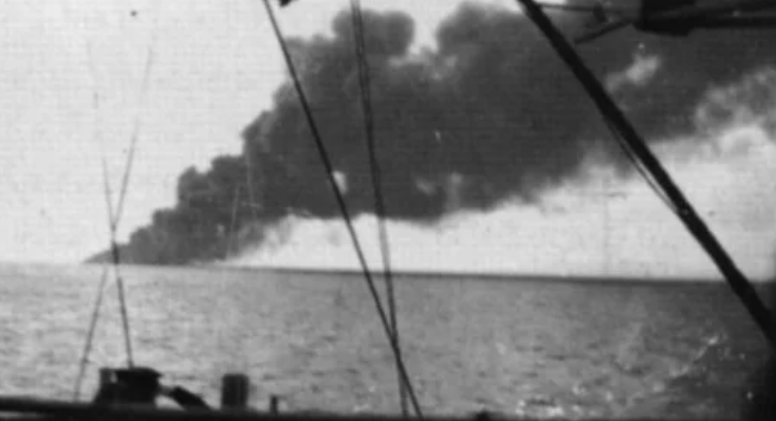
At the time of the explosion, there were five vessels a short distance away, and they made their way to the site. HMS ISLE OF SARK, a radar training ship, managed to rescue 35 survivors, although three passed away on board. SS LITHIUM, an ICI coastal ship, navigated through the burning oil to save 60 men. SS CRAGSMAN, a merchant vessel, steamed directly into the flames, successfully recovering 14 survivors, three of whom later succumbed. LA CAPRICIEUSE, a French destroyer, retrieved 26 survivors, and the minesweeper HMS SIR GALAHAD also promptly responded to the distress signal.
Out of the 528 personnel on board, only 149 survived, resulting in the loss of 379 lives in one of Britain’s worst naval disasters in its home waters. However, due to wartime censorship and secrecy, very few details about the sinking were made public at the time. Many families of the victims were not informed of their loved ones’ fates until years later. Some bodies were never recovered, and many were buried anonymously or without proper identification.
The exact cause of the explosion remains unclear. A court of inquiry held on DASHER’s sister ship ARCHER, just three days later, ruled out enemy action and concluded that it was an accident caused by “a defect which could not have been detected.” The inquiry determined that the first explosion took place in either the Petrol storage area or the rear Depth Charge Magazine (which housed 68 Depth Charges), which were located next to one another, and that a spark had ignited an accumulation of petrol vapour. It was presumed, although not explicitly mentioned, that the subsequent explosion involved the petrol storage tanks themselves igniting; the vessel contained 85,000 gallons of aviation petrol.4
Following the inquiry, the British Admiralty remarked that “safeguards against accidents of this nature are, by our standards, practically non-existent in the petrol arrangements and hangars of these American-built escort carriers”. The US Navy attributed the blame for the disaster to the inexperience of British officers in the handling of bulk petrol, and following the sinking, the Admiralty issued a warning that this was a source of danger on this class of ship.5
Interestingly and likely in error, the List of Admiralty Records (1942-1943), volume 6, Admiralty and Secretariat Papers states: “H.M.S. Dasher sunk by enemy action: next-of-kin informed; Review of Admiralty policy regarding degree of information given to next-of-kin when informed of their loss.”6
The wreck site lies 5 miles south of Little Cumbrae Island at a depth of 142 metres and is a designated war grave under the Protection of Military Remains Act. Memorials are located in Ardrossan and Brodick on the Isle of Arran, with annual memorial services held at the memorial garden in Ardrossan.
Out of the 379 men lost, only 23 bodies were officially accounted for and buried in local cemeteries such as Ardrossan and Greenock. This discrepancy has led families to campaign for the identification of unmarked mass graves on shore. The Royal Navy has maintained that unmarked mass burials would have gone against official Admiralty policy at the time.
Following claims that as many as 40 to 60 crew members had been buried in an unmarked mass grave at Ardrossan Cemetery, investigations were conducted there from 2010 to 2012 by Dr Tony Pollard and his team from the University of Glasgow’s Centre for Battlefield Archaeology and by GUARD Archaeology. A ground-penetrating radar survey and physical archaeological dig found no evidence of a mass grave.7
The crew of DASHER have been officially recognised as eligible for the Arctic Star medal, which the UK Ministry of Defence confirmed in January 2026, following a campaign by the families of those who served on board.
HMS DASHER and Operation MINCEMEAT
The loss of DASHER is connected to the deception operation MINCEMEAT through a theory proposing that the body of sailor John “Jack” Melville, who died in the sinking, was used as the “Man Who Never Was” to mislead German intelligence prior to the planned Allied invasion of Sicily. This theory suggests that Melville’s body offered a more suitable corpse for the deception than that of homeless man Glyndwr Michael, who had died two months before after ingesting rat poison and who is officially recognised as the fictitious Royal Marines officer, “Major William Martin”.
Authors John and Noreen Steele put forward the theory of John Melville’s body being used as the fictitious Major Martin in their book The Secrets of HMS Dasher. The theory alleges that the secretive handling of DASHER’s dead crew and the quick burial of bodies in unmarked graves was a cover-up to facilitate this.
However, Ewen Montagu, the officer responsible for Operation MINCEMEAT, stated in his book The Man Who Never Was that the body of a young man who had died of pneumonia was used in the operation.8 Pneumonia was significant as it indicated the presence of fluid in the lungs, which, in the case of an autopsy, would be consistent with a drowning death.
By planting fake invasion plans for Greece and Sardinia on the corpse and allowing it to wash ashore in Spain, British intelligence successfully tricked the Germans into moving forces away from the actual target of Sicily. This deception is estimated to have saved roughly 30,000 Allied lives.
In 2004, the Royal Navy held a memorial service for John Melville aboard the current HMS DASHER, where he was referred to as the “man who most certainly was,” seemingly acknowledging his role in the deception.9 However, in 2010, the Ministry of Defence stated that the Royal Navy had been mistaken and issued an apology to John Melville’s family.
Notes:
- S. W. Roskill, The War at Sea 1939-1945, vol 2, (London 1956), p 334. ↩︎
- Personal correspondence. ↩︎
- The War at Sea 1939-1945, p 367. ↩︎
- Royal Navy Research Archive: A History of HMS DASHER. ↩︎
- The War at Sea 1939-1945, p 367. ↩︎
- List of Admiralty Records (1942-1943), vol 6, (New York 1976), p 3; ADM 1/15419. ↩︎
- The Times, 24 October 2011; The Herald, 23 October 2012. ↩︎
- Ewen Montagu, The Man Who Never Was, (1954), p 30. ↩︎
- The Scotsman, 13 October 2004. ↩︎
Article first published on 18 March 2026; updated on 7 November 2026
Cite this article: Ritchie, N. S. (18 March 2026). The loss of HMS DASHER. British Military Journal. https://www.militaryjournal.co.uk/articles/the-loss-of-hms-dasher/
